Solar Eclipses
/https://public-media.si-cdn.com/filer/e1/9c/e19cb5ea-61d2-45c9-b7c1-ef830f3cd176/eclipse.jpg)
The Sun's face is hidden by the moon's dark disk as the corona glows softly around it. Stars and planets are visible that are usually washed out by the Sun's bright light. The air has cooled. Some flowers have closed their petals and night-blooming ones are opening. Bees are back in their hives and birds have stopped singing. It's a solar eclipse.
Solar eclipses have been viewed as ill omens, which is not surprising given our dependence on the Sun. Some ancient civilizations thought a dragon, a demon or some other creature was eating the sun. The Chinese would frighten it away with drums and shouting and other noise.
As seen from Earth, the Moon and Sun appear to be about the same size. Otherwise total solar eclipses couldn't occur. Although the Sun is 400 times bigger than the Moon, the Moon is 400 times closer to us.
The Moon's orbit is elliptical (shaped like a squashed circle), so the Moon's distance from us varies. If it's at its most distant at the time of an eclipse, its disk won't cover the Sun, so there is a ring of sunlight surrounding it. This is an annular eclipse.
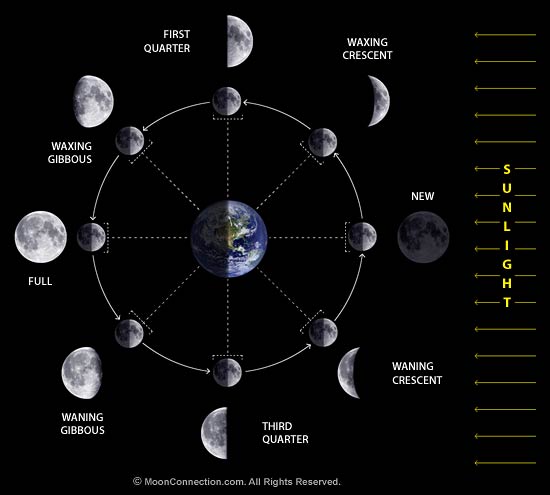
A solar eclipse occurs only during a new moon, and then only if the Earth, Moon and Sun are aligned. This doesn't happen every month. Earth orbits the Sun in what is called the ecliptic plane – this is also the plane of the Sun's apparent motion through the sky. Although the Moon orbits the Earth close to the ecliptic, it's slightly tilted to it. The two points where its orbit crosses the ecliptic are called nodes. If a new moon occurs when the Moon is near a node, then everything is lined up for a solar eclipse.
Since it's small compared to Earth the Moon's shadow is narrow. Any place where the darker part of the shadow (the umbra) falls would have a total eclipse, but within the outer part of the shadow (the penumbra) the eclipse is only partial.
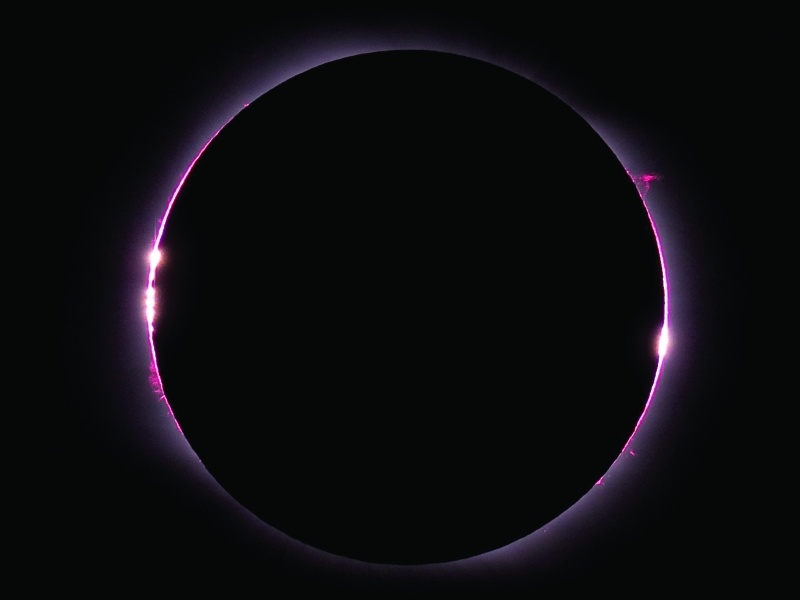
The irregular landscape of the Moon means that its edge isn't perfectly smooth as it passes in front of the sun. It looks as if there are beads of bright sunlight coming through valleys and between mountains. They are called Baily's beads in honor of British astronomer Francis Baily who first explained them. It also causes the lovely diamond ring effect.
A total or annular eclipse occurs somewhere in the world about every nine months. But at any particular location they are rare. For example, there was a total eclipse in Cornwall, England in 1999, but the next one isn't until 2090.
Predicting eclipses before the days of computers was tricky. It's based around the Saros cycle of just over eighteen years and was probably known to the ancient Babylonians. However working out from where on Earth the eclipse will be visible is quite complex.
Solar eclipses used to be the only time astronomers could study the solar corona. This is the region surrounding the Sun and it’s about a million times fainter than the disk of the Sun we normally see. Coronagraphs, especially on space telescopes, can now block out the bright center. However this doesn't give a complete picture, so solar eclipses continue to add to our understanding of the Sun.
Famously, Arthur Eddington made Einstein an international celebrity by testing his General Theory of Relativity during a solar eclipse. Yet it isn't just astronomers that are interested in eclipses. Biologists also study the effects of solar eclipses on animal behavior. Birds and insects seem to be particularly sensitive to the changes in light levels.
Modern eclipses aren't accompanied by demon-scaring clamor. The sounds would be the clicks of cameras, gasps of wonderment and perhaps delighted applause of onlookers.
Reference:
Tony Phillips, "There Goes the Sun," NASA Science News, 05.08.99
ROG learning team, "The Solar System: Eclipses," National Maritime Museum [accessed 05.07.10]
Credit header image: NASA/SDO and the AIA, EVE, and HMI science teams
Credit Bailey's beads image: Catalin Beldea (Descopera Magazine)
Credit diamond ring image: Rick Feinberg
WARNING
Never look directly at the Sun with a telescope or binoculars. It is extremely dangerous and can result in permanent blindness. It is also dangerous to look at a bright Sun with the unaided eye, even during a partial eclipse.
Solar eclipses have been viewed as ill omens, which is not surprising given our dependence on the Sun. Some ancient civilizations thought a dragon, a demon or some other creature was eating the sun. The Chinese would frighten it away with drums and shouting and other noise.
As seen from Earth, the Moon and Sun appear to be about the same size. Otherwise total solar eclipses couldn't occur. Although the Sun is 400 times bigger than the Moon, the Moon is 400 times closer to us.
The Moon's orbit is elliptical (shaped like a squashed circle), so the Moon's distance from us varies. If it's at its most distant at the time of an eclipse, its disk won't cover the Sun, so there is a ring of sunlight surrounding it. This is an annular eclipse.
A solar eclipse occurs only during a new moon, and then only if the Earth, Moon and Sun are aligned. This doesn't happen every month. Earth orbits the Sun in what is called the ecliptic plane – this is also the plane of the Sun's apparent motion through the sky. Although the Moon orbits the Earth close to the ecliptic, it's slightly tilted to it. The two points where its orbit crosses the ecliptic are called nodes. If a new moon occurs when the Moon is near a node, then everything is lined up for a solar eclipse.
Since it's small compared to Earth the Moon's shadow is narrow. Any place where the darker part of the shadow (the umbra) falls would have a total eclipse, but within the outer part of the shadow (the penumbra) the eclipse is only partial.
The irregular landscape of the Moon means that its edge isn't perfectly smooth as it passes in front of the sun. It looks as if there are beads of bright sunlight coming through valleys and between mountains. They are called Baily's beads in honor of British astronomer Francis Baily who first explained them. It also causes the lovely diamond ring effect.
A total or annular eclipse occurs somewhere in the world about every nine months. But at any particular location they are rare. For example, there was a total eclipse in Cornwall, England in 1999, but the next one isn't until 2090.
Predicting eclipses before the days of computers was tricky. It's based around the Saros cycle of just over eighteen years and was probably known to the ancient Babylonians. However working out from where on Earth the eclipse will be visible is quite complex.
Solar eclipses used to be the only time astronomers could study the solar corona. This is the region surrounding the Sun and it’s about a million times fainter than the disk of the Sun we normally see. Coronagraphs, especially on space telescopes, can now block out the bright center. However this doesn't give a complete picture, so solar eclipses continue to add to our understanding of the Sun.
Famously, Arthur Eddington made Einstein an international celebrity by testing his General Theory of Relativity during a solar eclipse. Yet it isn't just astronomers that are interested in eclipses. Biologists also study the effects of solar eclipses on animal behavior. Birds and insects seem to be particularly sensitive to the changes in light levels.
Modern eclipses aren't accompanied by demon-scaring clamor. The sounds would be the clicks of cameras, gasps of wonderment and perhaps delighted applause of onlookers.
Reference:
Tony Phillips, "There Goes the Sun," NASA Science News, 05.08.99
ROG learning team, "The Solar System: Eclipses," National Maritime Museum [accessed 05.07.10]
Credit header image: NASA/SDO and the AIA, EVE, and HMI science teams
Credit Bailey's beads image: Catalin Beldea (Descopera Magazine)
Credit diamond ring image: Rick Feinberg
You Should Also Read:
Lunar Eclipses
Are There Solar Eclipses on the Moon
Einstein's Eclipse

Related Articles
Editor's Picks Articles
Top Ten Articles
Previous Features
Site Map
Content copyright © 2023 by Mona Evans. All rights reserved.
This content was written by Mona Evans. If you wish to use this content in any manner, you need written permission. Contact Mona Evans for details.