10 Amazing Facts about the Solar System
1. The Sun is shrinking - should we worry?
The Sun loses about five and a half million metric tons of mass every second. Most of this is due to nuclear fusion changing mass into energy according to Einstein's famous equation E=mcsquared. In addition, a stream of charged particles, called the solar wind, is being blown out from the Sun's atmosphere.
But we needn't worry. Although it may sound like a lot of lost matter, the amount is insignificant compared to the mass of the Sun. Our star contains 99.8% of the mass of the whole Solar System, the remainder comprising the planets, dwarf planets, moons, asteroids, comets, Kuiper Belt objects and interplanetary gas and dust.
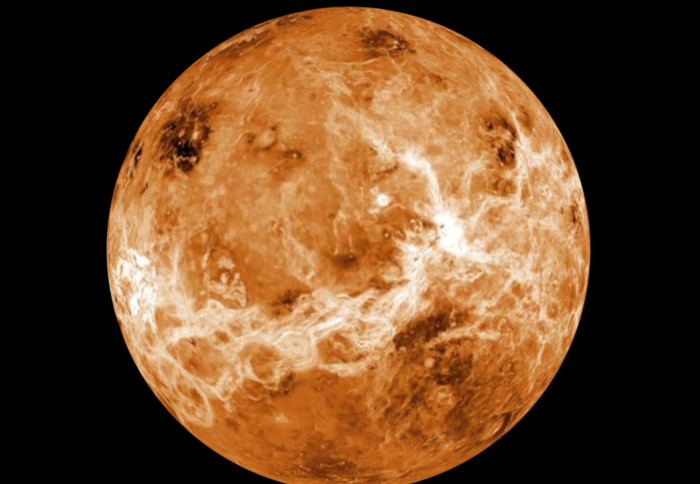
2. Although Mercury is the planet nearest the Sun, Venus is hotter than Mercury.
Clear nights on Earth tend to be colder than cloudy ones, because clouds act like a blanket to keep the heat in. Venus seems to have suffered from a runaway greenhouse effect and is covered in a thick carbon dioxide atmosphere. It's ended up with an atmosphere so thick that the surface air pressure is 90 times that on Earth. The surface temperature is 460 °C - well above the temperature needed to melt lead.
3. The days on Earth are getting longer.
Evidence from fossil corals shows that 350 million years ago a day was about 23 hours long, and older fossils indicate even shorter days. Earth's rotation is slowing due to tidal interactions with the Moon and the Sun. But if you feel that there aren't enough hours in the day, I should mention that it takes a century to lengthen the day by 1.7 milliseconds. This adds up in geologic time, but isn't much help now for a busy person.
4. There are pieces of the asteroid Vesta on Earth.
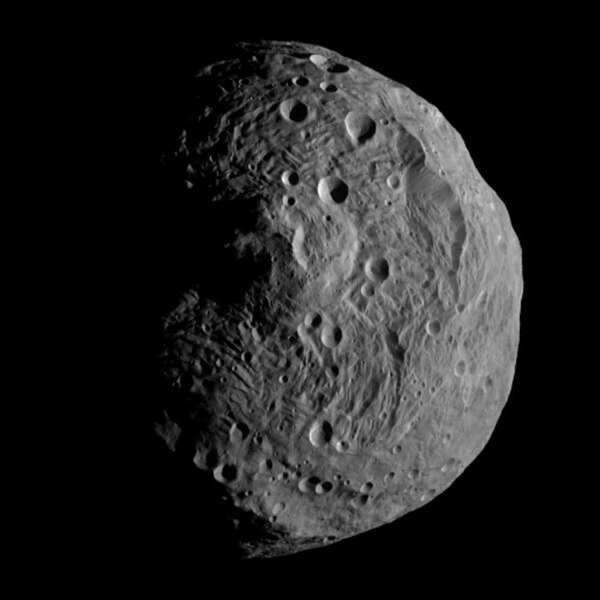
Although it's not normally possible to say that a meteorite came from a particular asteroid, there is substantial evidence that a certain type of meteorite came from Vesta. These meteorites are thought to be some of the debris from the massive impact which created the Rheasilvia crater. The Dawn spacecraft took this picture of it. You might have some difficulty picking out the crater in the picture. It's 505 km (314 miles) across and covers most of the southern hemisphere, so the picture is almost all crater.
5. The biggest volcano in the Solar System dwarfs Everest.
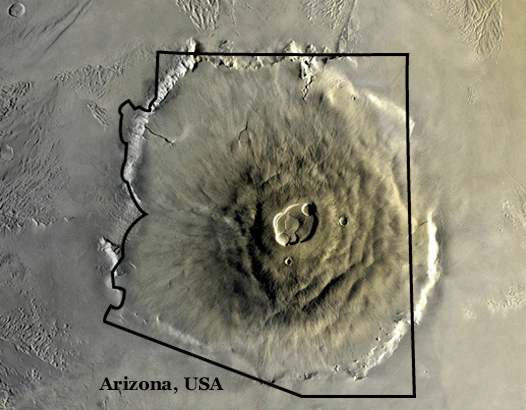
Olympus Mons on Mars is nearly three times the height of Mount Everest at nearly 22 km (14 miles). You can see a picture taken from orbit with the size of Olympus Mons compared to the state of Arizona in the USA.
Olympus Mons is a shield volcano, the same type as Earth's largest volcano, Mauna Loa in Hawaii. Mauna Loa rises 17 km (10.6 miles) from its base on the sea floor and its weight bends the ocean's crust under it. However the lower gravity of Mars allows a volcano to grow much bigger than it could on Earth.
6. Jupiter is bigger than all the other planets put together.
If you had a container as big as Jupiter, you could fit the other seven planets inside it, plus all the moons, dwarf planets and asteroids in the Solar System. In fact, after stuffing all that into your container, there would still be space left over.
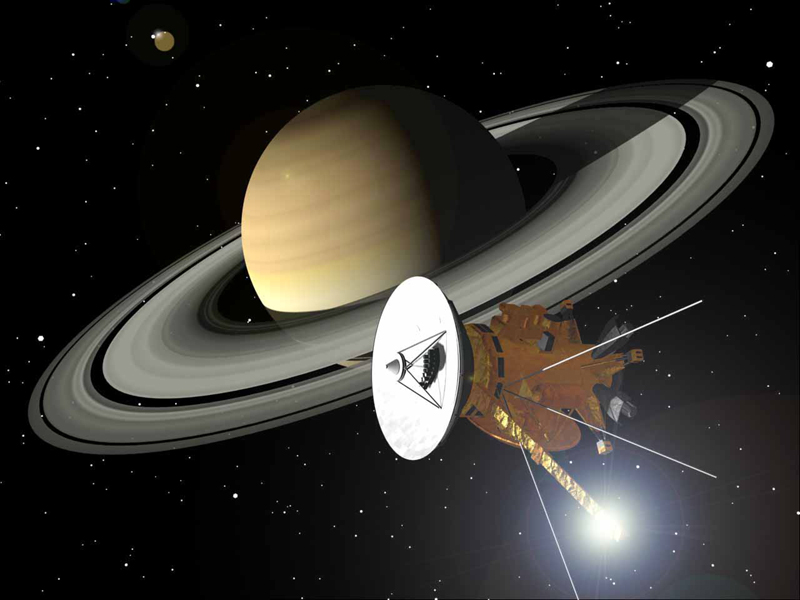
7. One of Saturn's moons has an atmosphere similar to Earth's.
Most moons with an atmosphere have a very tenuous one. Saturn's moon Titan is the exception. We tend to think of our own atmosphere in terms of the amount of oxygen (21%). However 78% of it is nitrogen. Titan's atmosphere is predominantly nitrogen, but also contains methane and other organic molecules. Its atmosphere is closer to Earth's atmosphere of long ago, before photosynthesizing organisms started to release quantities of oxygen into the atmosphere. Titan may well have the elements needed for life to begin.
8. Uranus orbits on its side.
Earth's axis is tilted about 23°, causing our familiar seasons. But the axis of Uranus is tilted 98°, which means it's orbiting on its side. Earth's polar regions get periods of continuous darkness or light around the times of the solstices. On Uranus the polar regions get 42 years of light alternating with 42 years of darkness. There are day and night cycles around the equator during the times of the spring and fall equinoxes.
9. Saturn isn't the only planet with rings.
All of the giant planets have rings, but Saturn's are the prettiest and most prominent. Uranian moons were discovered from Earth, but not by being seen. It was because of the way the light from a star dipped several times when it was occulted (hidden) by Uranus. There was also some occultation evidence for rings around Neptune and this was confirmed by the Voyager spacecraft. It was Voyager 1 that discovered Jupiter's faint dusty rings in 1979.
10. Neptune was discovered a little over a year ago.
Johann Galle found Neptune on September 24, 1846, but there wasn't a full Neptunian year until July 12, 2011.
My Pinterest board Amazing Solar System has images related to this article.

The Sun loses about five and a half million metric tons of mass every second. Most of this is due to nuclear fusion changing mass into energy according to Einstein's famous equation E=mcsquared. In addition, a stream of charged particles, called the solar wind, is being blown out from the Sun's atmosphere.
But we needn't worry. Although it may sound like a lot of lost matter, the amount is insignificant compared to the mass of the Sun. Our star contains 99.8% of the mass of the whole Solar System, the remainder comprising the planets, dwarf planets, moons, asteroids, comets, Kuiper Belt objects and interplanetary gas and dust.
2. Although Mercury is the planet nearest the Sun, Venus is hotter than Mercury.
Clear nights on Earth tend to be colder than cloudy ones, because clouds act like a blanket to keep the heat in. Venus seems to have suffered from a runaway greenhouse effect and is covered in a thick carbon dioxide atmosphere. It's ended up with an atmosphere so thick that the surface air pressure is 90 times that on Earth. The surface temperature is 460 °C - well above the temperature needed to melt lead.
3. The days on Earth are getting longer.
Evidence from fossil corals shows that 350 million years ago a day was about 23 hours long, and older fossils indicate even shorter days. Earth's rotation is slowing due to tidal interactions with the Moon and the Sun. But if you feel that there aren't enough hours in the day, I should mention that it takes a century to lengthen the day by 1.7 milliseconds. This adds up in geologic time, but isn't much help now for a busy person.
4. There are pieces of the asteroid Vesta on Earth.
Although it's not normally possible to say that a meteorite came from a particular asteroid, there is substantial evidence that a certain type of meteorite came from Vesta. These meteorites are thought to be some of the debris from the massive impact which created the Rheasilvia crater. The Dawn spacecraft took this picture of it. You might have some difficulty picking out the crater in the picture. It's 505 km (314 miles) across and covers most of the southern hemisphere, so the picture is almost all crater.
5. The biggest volcano in the Solar System dwarfs Everest.
Olympus Mons on Mars is nearly three times the height of Mount Everest at nearly 22 km (14 miles). You can see a picture taken from orbit with the size of Olympus Mons compared to the state of Arizona in the USA.
Olympus Mons is a shield volcano, the same type as Earth's largest volcano, Mauna Loa in Hawaii. Mauna Loa rises 17 km (10.6 miles) from its base on the sea floor and its weight bends the ocean's crust under it. However the lower gravity of Mars allows a volcano to grow much bigger than it could on Earth.
6. Jupiter is bigger than all the other planets put together.
If you had a container as big as Jupiter, you could fit the other seven planets inside it, plus all the moons, dwarf planets and asteroids in the Solar System. In fact, after stuffing all that into your container, there would still be space left over.
7. One of Saturn's moons has an atmosphere similar to Earth's.
Most moons with an atmosphere have a very tenuous one. Saturn's moon Titan is the exception. We tend to think of our own atmosphere in terms of the amount of oxygen (21%). However 78% of it is nitrogen. Titan's atmosphere is predominantly nitrogen, but also contains methane and other organic molecules. Its atmosphere is closer to Earth's atmosphere of long ago, before photosynthesizing organisms started to release quantities of oxygen into the atmosphere. Titan may well have the elements needed for life to begin.
8. Uranus orbits on its side.
Earth's axis is tilted about 23°, causing our familiar seasons. But the axis of Uranus is tilted 98°, which means it's orbiting on its side. Earth's polar regions get periods of continuous darkness or light around the times of the solstices. On Uranus the polar regions get 42 years of light alternating with 42 years of darkness. There are day and night cycles around the equator during the times of the spring and fall equinoxes.
9. Saturn isn't the only planet with rings.
All of the giant planets have rings, but Saturn's are the prettiest and most prominent. Uranian moons were discovered from Earth, but not by being seen. It was because of the way the light from a star dipped several times when it was occulted (hidden) by Uranus. There was also some occultation evidence for rings around Neptune and this was confirmed by the Voyager spacecraft. It was Voyager 1 that discovered Jupiter's faint dusty rings in 1979.
10. Neptune was discovered a little over a year ago.
Johann Galle found Neptune on September 24, 1846, but there wasn't a full Neptunian year until July 12, 2011.
My Pinterest board Amazing Solar System has images related to this article.
You Should Also Read:
Venus Facts for Kids
Jupiter
Uranus and Neptune Twin Planets

Related Articles
Editor's Picks Articles
Top Ten Articles
Previous Features
Site Map
Content copyright © 2023 by Mona Evans. All rights reserved.
This content was written by Mona Evans. If you wish to use this content in any manner, you need written permission. Contact Mona Evans for details.