Kuiper Belt

Pluto is no longer the last outpost of the Solar System, but rather the gateway to the Kuiper Belt. The Kuiper Belt is composed of left-overs from the formation of the Solar System, a bigger and colder version of the asteroid belt.
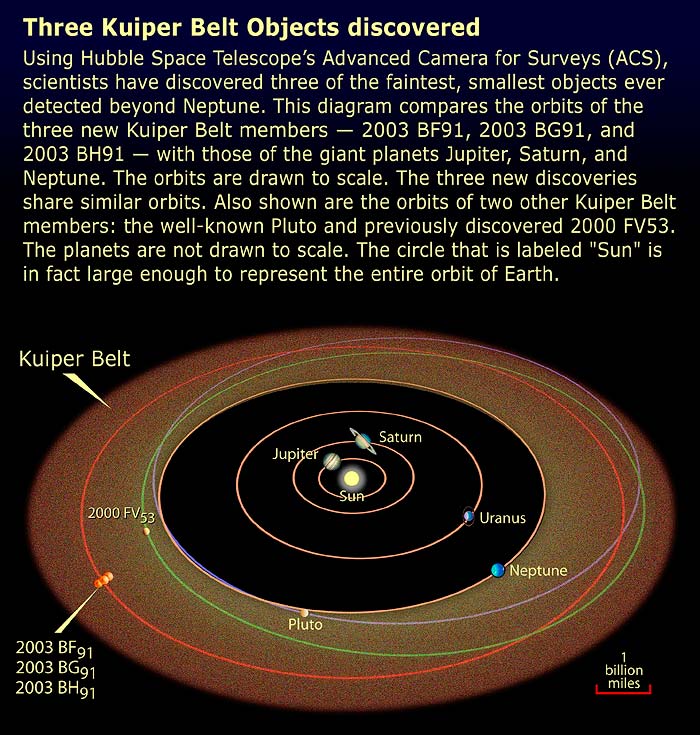
It’s hard to imagine how large and distant the Kuiper Belt is, but you can click here to see a diagram of the Solar System to scale. In order to include the Kuiper Belt the "Sun" covers the orbits of Mars, Venus and Earth, and neither Mars nor the asteroid belt is shown.
Neptune, whose orbit is the inner boundary of the Kuiper Belt, is about 4.5 billion km (2.8 billion miles) from the Sun. Astronomers prefer to talk about these big distances in astronomical units (AU) where 1 AU is the distance from the Earth to the Sun. Since Neptune is 30 AU from the Sun, it’s thirty times farther from the Sun than we are. The belt then extends at least a further 20 AU.
The objects beyond Neptune’s orbit are called trans-Neptunian objects (TNOs). Those in the Kuiper Belt are also Kuiper Belt Objects (KBOs). Three KBOs have already been designated as dwarf planets: Pluto, Haumea (how MAY ah) and Makemake (MAH kay MAH kay). These three dwarf planets are unusually large for the Kuiper Belt, but are still smaller than our Moon.
The main materials of the Kuiper Belt are various “icy volatiles” and rock. Icy volatiles are substances such as water, ammonia and methane that are liquids or gases on Earth, but frozen in the outer Solar System.
It’s estimated that there are at least 70,000 KBOs of 100 km (62 miles) or more across, and millions of smaller ones. Yet although the Kuiper Belt is large and its contents are numerous, the KBOs are small, widely spaced and low in density. If you could gather them all up to make one object, you’d need at least nine more Kuiper Belts for an object with the mass of the Earth.
The first object to be discovered beyond Pluto and Charon is known as 1992 QB1. After five years of searching, English astronomer David Jewitt and Vietnamese-born American astronomer Jane Luu found it in August 1992. The date of this discovery is often given as the discovery date of the Kuiper Belt.
Astronomers had discussed the existence of such a region for many decades. In fact, it was soon after Pluto’s discovery in 1930 that American astronomer Frederick C. Leonard (1896-1960) suggested that Pluto might not be a new planet, but the first of a new class of objects. In 1943 Irish astronomer Kenneth Edgeworth (1880-1972) wrote that the outer region of the Solar System should contain a large number of small bodies, and he also thought it would be a source of comets.
Interestingly, Dutch-American astronomer Gerard Kuiper (1905-1973) independently proposed in 1951 that a disk of small icy bodies would be left over from the formation of the Solar System. Despite his conclusion that the disk no longer existed, it was named for him, though it’s also called the Edgeworth-Kuiper Belt.
Pluto and Charon, of course, are trans-Neptunian objects. For twenty years of their 248-year orbit they are closer to the Sun than Neptune, but they travel well beyond this during the remainder of the orbit. Pluto was the first KBO discovered, but it took six decades to confirm that it wasn't unique. Since 1992 over 1300 trans-Neptunian objects have been discovered.
About two-thirds of objects observed in the Kuiper Belt lie between 42-48 AU. This region is known as the classical Kuiper belt. Away from the influence of Neptune's gravity, the objects here have stable orbits. There seem to be two distinct populations, which differ in color and orbital characteristics.
The first type have orbits like planets — nearly circular and close to the ecliptic (the plane of the Solar System). They probably formed where they are now. The second type have more elongated orbits that are tilted at an angle to the ecliptic. They probably formed closer to the Sun, moving outwards when Uranus and Neptune did.
The Kuiper Belt seems to be the back of beyond. It’s so far away from us that the Sun would just look like a particularly bright star. Yet there’s more. Even farther away than the Kuiper Belt is the Scattered Disk — it stretches out another 50 AU. Scattered disk objects have very elongated orbits crossing the plane of the Solar System at steep angles.
Eris was discovered in the Scattered Disk in 2005. Since it seemed to be bigger than Pluto, this finally pushed the International Astronomical Union into defining a planet. On this diagram you can see the orbits of Pluto and Eris. Eris’s orbit is at angle of more than forty degrees to the ecliptic. White dots represent classical KBOs.
Scattered Disk objects often come close enough to be affected by Neptune's gravity, so their orbits are unstable. Some short-period comets also come from the disk, but most originate in the Oort Cloud. Astronomers think the Oort cloud surrounds the Solar System, starting at perhaps 10,000 AU and extending as far as 100,000 AU or more.
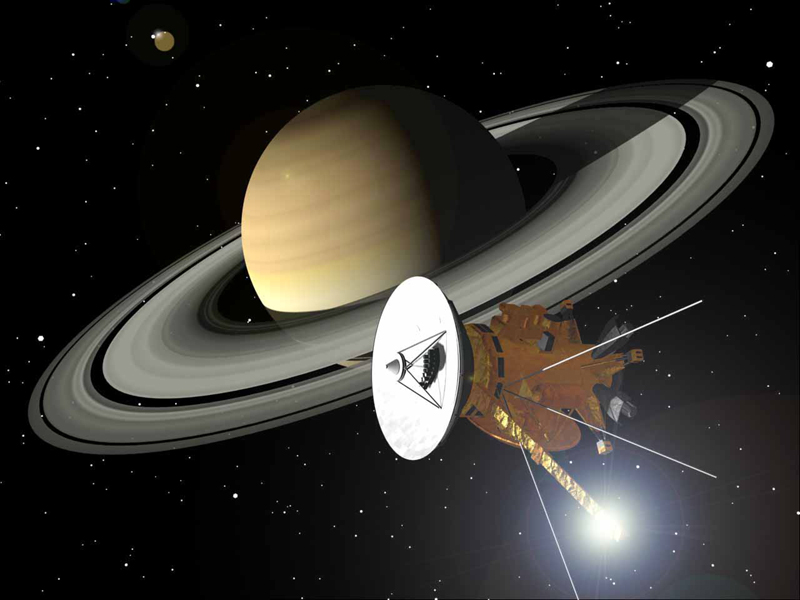
NASA’s New Horizons probe has visited Pluto, and is on the way to another Kuiper Belt object.
References:
(1) “Kuiper Belt of Many Colors” https://www.nasa.gov/topics/solarsystem/sunearthsystem/main/kuiper-colors.html
(2) “Kuiper Belt and Oort cloud Lithograph” https://www.nasa.gov/audience/foreducators/topnav/materials/listbytype/Kuiper_Belt_Lithograph.html
(3) “Types of Trans-Neptunian Objects” https://planetary.org/explore/topics/trans_neptunian_objects/facts.html (accessed 2011-07-24)
It’s hard to imagine how large and distant the Kuiper Belt is, but you can click here to see a diagram of the Solar System to scale. In order to include the Kuiper Belt the "Sun" covers the orbits of Mars, Venus and Earth, and neither Mars nor the asteroid belt is shown.
Neptune, whose orbit is the inner boundary of the Kuiper Belt, is about 4.5 billion km (2.8 billion miles) from the Sun. Astronomers prefer to talk about these big distances in astronomical units (AU) where 1 AU is the distance from the Earth to the Sun. Since Neptune is 30 AU from the Sun, it’s thirty times farther from the Sun than we are. The belt then extends at least a further 20 AU.
The objects beyond Neptune’s orbit are called trans-Neptunian objects (TNOs). Those in the Kuiper Belt are also Kuiper Belt Objects (KBOs). Three KBOs have already been designated as dwarf planets: Pluto, Haumea (how MAY ah) and Makemake (MAH kay MAH kay). These three dwarf planets are unusually large for the Kuiper Belt, but are still smaller than our Moon.
The main materials of the Kuiper Belt are various “icy volatiles” and rock. Icy volatiles are substances such as water, ammonia and methane that are liquids or gases on Earth, but frozen in the outer Solar System.
It’s estimated that there are at least 70,000 KBOs of 100 km (62 miles) or more across, and millions of smaller ones. Yet although the Kuiper Belt is large and its contents are numerous, the KBOs are small, widely spaced and low in density. If you could gather them all up to make one object, you’d need at least nine more Kuiper Belts for an object with the mass of the Earth.
The first object to be discovered beyond Pluto and Charon is known as 1992 QB1. After five years of searching, English astronomer David Jewitt and Vietnamese-born American astronomer Jane Luu found it in August 1992. The date of this discovery is often given as the discovery date of the Kuiper Belt.
Astronomers had discussed the existence of such a region for many decades. In fact, it was soon after Pluto’s discovery in 1930 that American astronomer Frederick C. Leonard (1896-1960) suggested that Pluto might not be a new planet, but the first of a new class of objects. In 1943 Irish astronomer Kenneth Edgeworth (1880-1972) wrote that the outer region of the Solar System should contain a large number of small bodies, and he also thought it would be a source of comets.
Interestingly, Dutch-American astronomer Gerard Kuiper (1905-1973) independently proposed in 1951 that a disk of small icy bodies would be left over from the formation of the Solar System. Despite his conclusion that the disk no longer existed, it was named for him, though it’s also called the Edgeworth-Kuiper Belt.
Pluto and Charon, of course, are trans-Neptunian objects. For twenty years of their 248-year orbit they are closer to the Sun than Neptune, but they travel well beyond this during the remainder of the orbit. Pluto was the first KBO discovered, but it took six decades to confirm that it wasn't unique. Since 1992 over 1300 trans-Neptunian objects have been discovered.
About two-thirds of objects observed in the Kuiper Belt lie between 42-48 AU. This region is known as the classical Kuiper belt. Away from the influence of Neptune's gravity, the objects here have stable orbits. There seem to be two distinct populations, which differ in color and orbital characteristics.
The first type have orbits like planets — nearly circular and close to the ecliptic (the plane of the Solar System). They probably formed where they are now. The second type have more elongated orbits that are tilted at an angle to the ecliptic. They probably formed closer to the Sun, moving outwards when Uranus and Neptune did.
The Kuiper Belt seems to be the back of beyond. It’s so far away from us that the Sun would just look like a particularly bright star. Yet there’s more. Even farther away than the Kuiper Belt is the Scattered Disk — it stretches out another 50 AU. Scattered disk objects have very elongated orbits crossing the plane of the Solar System at steep angles.
Eris was discovered in the Scattered Disk in 2005. Since it seemed to be bigger than Pluto, this finally pushed the International Astronomical Union into defining a planet. On this diagram you can see the orbits of Pluto and Eris. Eris’s orbit is at angle of more than forty degrees to the ecliptic. White dots represent classical KBOs.
Scattered Disk objects often come close enough to be affected by Neptune's gravity, so their orbits are unstable. Some short-period comets also come from the disk, but most originate in the Oort Cloud. Astronomers think the Oort cloud surrounds the Solar System, starting at perhaps 10,000 AU and extending as far as 100,000 AU or more.
NASA’s New Horizons probe has visited Pluto, and is on the way to another Kuiper Belt object.
References:
(1) “Kuiper Belt of Many Colors” https://www.nasa.gov/topics/solarsystem/sunearthsystem/main/kuiper-colors.html
(2) “Kuiper Belt and Oort cloud Lithograph” https://www.nasa.gov/audience/foreducators/topnav/materials/listbytype/Kuiper_Belt_Lithograph.html
(3) “Types of Trans-Neptunian Objects” https://planetary.org/explore/topics/trans_neptunian_objects/facts.html (accessed 2011-07-24)
You Should Also Read:
Eris - Dwarf Planet
Dwarf Planets - a Tour
Pluto Is a Dwarf Planet

Related Articles
Editor's Picks Articles
Top Ten Articles
Previous Features
Site Map
Content copyright © 2023 by Mona Evans. All rights reserved.
This content was written by Mona Evans. If you wish to use this content in any manner, you need written permission. Contact Mona Evans for details.