What Is Hanny's Voorwerp
Hanny's Voorwerp was first seen in 2007 - a strange blue blob in the constellation of Leo Minor. Since then it has been imaged by large telescopes in visible light, ultraviolet light, infrared light, radio waves and X-rays, but astronomers still don't agree about the mystery object.
We know that the voorwerp is enormous, easily the size of our Milky Way, and that it's also around 650 million light years away. Since one light year is nearly six trillion miles (about ten and a half trillion kilometers), you can see that this is a stupendously large distance. However none of this tells us what Hanny's Voorwerp is, so let's start by going back before the time of its discovery.
In these days of identifying new stars, galaxies and supernovae with catalog numbers and coordinates, it's unusual to associate a new object with a real person. However Hanny is Hanny van Arkel, a Dutch schoolteacher who teaches biology, but also loves music and plays the guitar. It was music that led her to astronomy.
The idea of the music of the spheres is an ancient one, but in Hanny's case the music wasn't that of the spheres, but of the rock band Queen. Hanny is a big fan and one day she was reading Brian May's blog. In addition to being one of the most famous rock musicians in the world, May also has a doctorate in astrophysics. In the blog he wrote about about the citizen science project Galaxy Zoo, and Hanny decided to have a look.
People who joined the Galaxy Zoo project were asked to classify galaxies from the Sloan Digital Sky Survey in order to help make a useful database out of images of over a million galaxies. People do this much better than computers because our brains are good at recognizing patterns. However the time needed would make it an impossible task for professional astronomers.
But what if there were lots and lots of people working at it? This was the idea that led to the Galaxy Zoo project. And, in addition, people have another advantage over computers: they are curious. Those taking part were encouraged to ask questions about anything unusual they found.
A week after Hanny started with the Galaxy Zoo, she classified the galaxy in this picture and started a forum thread with the question "What's the blue stuff below?"
A lengthy discussion came out of Hanny's question, but no one knew what her "voorwerp" (Dutch for object) was, although they were quite intrigued by it. In fact, various astronomers were interested enough to write proposals for the telescope time that has imaged the object at many wavelengths.
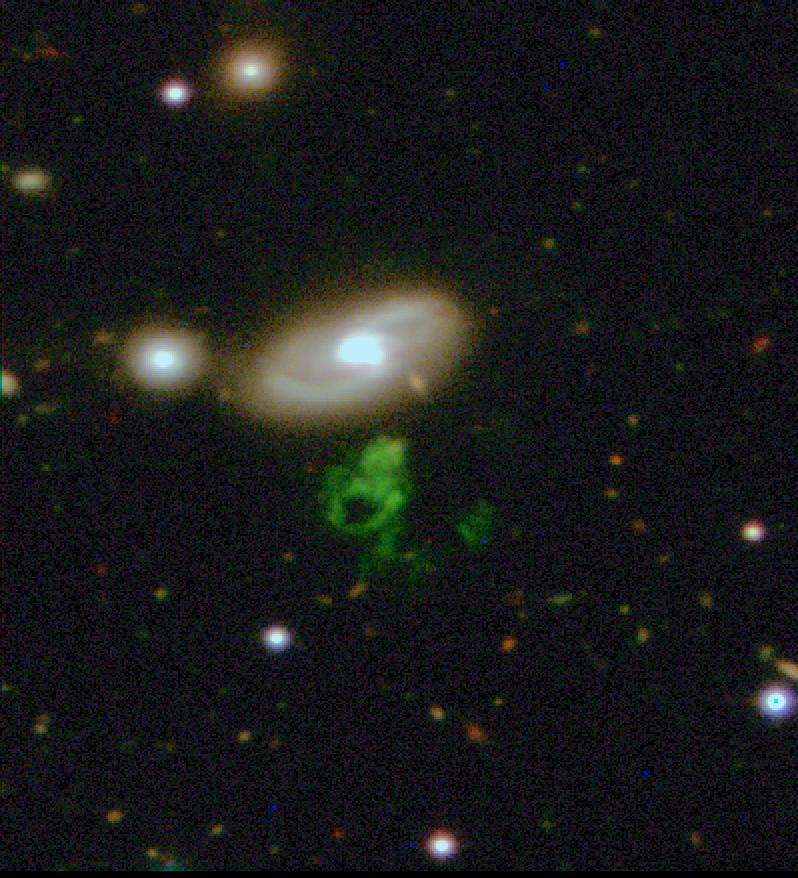
Here is the 2008 image of the voorwerp from the Isaac Newton Telescope in the Canary Islands. The picture was taken in visible light and shows that the object is not blue, but green. The observers were also able to work out that the voorwerp is about the same distance from us as the nearby spiral galaxy IC 2497. Delightfully, though not scientifically, it also shows the voorwerp looking very much like a frog.
Two research teams studied the voorwerp and presented papers on their findings. One team is American and British, and connected with the Galaxy Zoo project. The other was led by M.A. Garrett of ASTRON, the Netherlands Institute for Radio Astronomy.
Both teams agreed that an Active Galactic Nucleus (AGN) is involved. An AGN is the bright, compact galactic center which dominates some galaxies. They are so bright that their light swamps the light from the rest of the galaxy. The most luminous type of AGN is a quasar, but there are others. Their energy comes from an enormous black hole which is accreting (collecting) gas, a process that releases vast amounts of radiation.
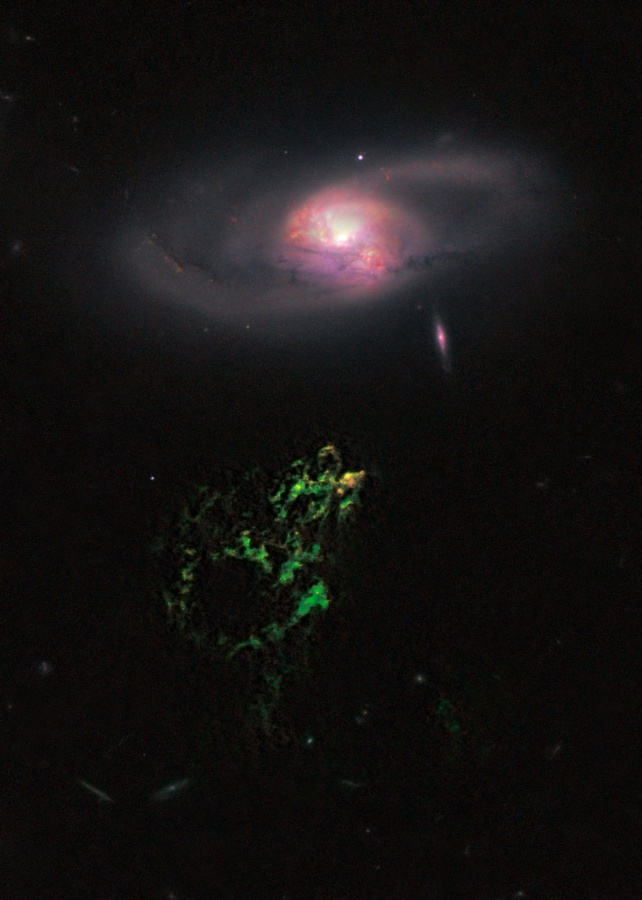
The Zoo team says the voorwerp is part of a tail of gas which came from a dwarf galaxy that was pulled apart when it got too close to IC 2497. It glows because it was energized by a quasar at the core of the spiral galaxy, which has since switched off. This image of the voorwerp was produced from high resolution data from the Hubble Space Telescope. The small yellow area on the voorwerp is a region of star formation.
The Dutch team made high resolution radio observations and their evidence lead them to believe that the AGN is still active and that that Hanny's Voorwerp is a nebula in which the gas is ionized (excited) by the radiation from it. The AGN itself can't be seen from Earth because it is obscured along our line of sight.
When she spoke at Astrofest 2012 in London, Hanny noted that she is listed as one of the authors on both papers and laughed, "So I am contradicting myself!"
No one has found another voorwerp, but there are a number of smaller objects that seem to be similar. They have been named voorwerpjes, which means "little objects". This story still has some way to go.

We know that the voorwerp is enormous, easily the size of our Milky Way, and that it's also around 650 million light years away. Since one light year is nearly six trillion miles (about ten and a half trillion kilometers), you can see that this is a stupendously large distance. However none of this tells us what Hanny's Voorwerp is, so let's start by going back before the time of its discovery.
In these days of identifying new stars, galaxies and supernovae with catalog numbers and coordinates, it's unusual to associate a new object with a real person. However Hanny is Hanny van Arkel, a Dutch schoolteacher who teaches biology, but also loves music and plays the guitar. It was music that led her to astronomy.
The idea of the music of the spheres is an ancient one, but in Hanny's case the music wasn't that of the spheres, but of the rock band Queen. Hanny is a big fan and one day she was reading Brian May's blog. In addition to being one of the most famous rock musicians in the world, May also has a doctorate in astrophysics. In the blog he wrote about about the citizen science project Galaxy Zoo, and Hanny decided to have a look.
People who joined the Galaxy Zoo project were asked to classify galaxies from the Sloan Digital Sky Survey in order to help make a useful database out of images of over a million galaxies. People do this much better than computers because our brains are good at recognizing patterns. However the time needed would make it an impossible task for professional astronomers.
But what if there were lots and lots of people working at it? This was the idea that led to the Galaxy Zoo project. And, in addition, people have another advantage over computers: they are curious. Those taking part were encouraged to ask questions about anything unusual they found.
A week after Hanny started with the Galaxy Zoo, she classified the galaxy in this picture and started a forum thread with the question "What's the blue stuff below?"
A lengthy discussion came out of Hanny's question, but no one knew what her "voorwerp" (Dutch for object) was, although they were quite intrigued by it. In fact, various astronomers were interested enough to write proposals for the telescope time that has imaged the object at many wavelengths.
Here is the 2008 image of the voorwerp from the Isaac Newton Telescope in the Canary Islands. The picture was taken in visible light and shows that the object is not blue, but green. The observers were also able to work out that the voorwerp is about the same distance from us as the nearby spiral galaxy IC 2497. Delightfully, though not scientifically, it also shows the voorwerp looking very much like a frog.
Two research teams studied the voorwerp and presented papers on their findings. One team is American and British, and connected with the Galaxy Zoo project. The other was led by M.A. Garrett of ASTRON, the Netherlands Institute for Radio Astronomy.
Both teams agreed that an Active Galactic Nucleus (AGN) is involved. An AGN is the bright, compact galactic center which dominates some galaxies. They are so bright that their light swamps the light from the rest of the galaxy. The most luminous type of AGN is a quasar, but there are others. Their energy comes from an enormous black hole which is accreting (collecting) gas, a process that releases vast amounts of radiation.
The Zoo team says the voorwerp is part of a tail of gas which came from a dwarf galaxy that was pulled apart when it got too close to IC 2497. It glows because it was energized by a quasar at the core of the spiral galaxy, which has since switched off. This image of the voorwerp was produced from high resolution data from the Hubble Space Telescope. The small yellow area on the voorwerp is a region of star formation.
The Dutch team made high resolution radio observations and their evidence lead them to believe that the AGN is still active and that that Hanny's Voorwerp is a nebula in which the gas is ionized (excited) by the radiation from it. The AGN itself can't be seen from Earth because it is obscured along our line of sight.
When she spoke at Astrofest 2012 in London, Hanny noted that she is listed as one of the authors on both papers and laughed, "So I am contradicting myself!"
No one has found another voorwerp, but there are a number of smaller objects that seem to be similar. They have been named voorwerpjes, which means "little objects". This story still has some way to go.
You Should Also Read:
Citizen Science in the Electronic Age
Young Astronomers Reveal the Universe
Quasar Facts for Kids

Related Articles
Editor's Picks Articles
Top Ten Articles
Previous Features
Site Map
Content copyright © 2023 by Mona Evans. All rights reserved.
This content was written by Mona Evans. If you wish to use this content in any manner, you need written permission. Contact Mona Evans for details.