

Joy for a Sore Back

An Unusual Solution
The BackJoy is an odd looking device. Essentially, it's a plastic curve with some modeling to fit the human shape.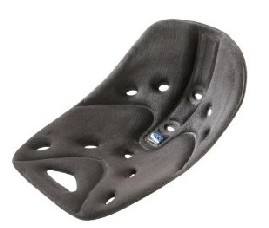
It works on a very basic principle: the back moves as a unit
The Spine
The spine is composed of 4 curves. These are(starting from the bottom) the sacral, lumbar, thoracic, and cervical. They are linked together in a semi-flexible manner that allows for a flexible posture in movement yet provides stability needed for standing erect and forceful action.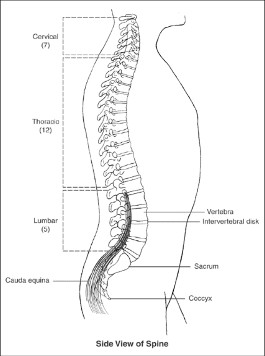
In each section of the vertebrae the bones are shaped to serve specific functions. The cervical vertebrae is designed to allow the greatest movement possible so that we can direct our face and eyes in a wide variety of directions. The lumbar area is designed to allow torque and twisting motions. The thoracic spine connect the mobile upper torso with the more supportive lower body. The lumbar and sacral-coccyx structures form the basis of posture and allow the upper curves to make the best use of their mobility.
In the diagram above, you can see the four different spinal curves clearly. This is the natural position in a relaxed posture. As we go through life, each movement we make changes the contour. Balance in maintained by the reciprocal movement in the sections. If one moves forward, another moves back. If one moves right, another moves left.
BackJoy's Approach
The BackJoy is designed to create a good postural alignment between the sacrum and lumbar areas. This in turn promotes (but does not force) the other spinal curves into the most functional position for seated work.The curved design of the BackJoy promotes spinal mobility while providing good postural control at the base. So, although it cups your 'buns' it does not limit side to side or front to back movement.
Technique
Like most simple gadgets, there is a technique to sitting correctly in the BackJoy.If you sit too far forward, you will end up with no postural improvement, and indeed at times actually sliding out it and sitting on the front edge of your chair. Because of the slope created by the BackJoy, this is more uncomfortable than sitting forward on the chair without the Backjoy.
If you sit too far back, you will may maintain minimal sacral -coccyx support, but will loose the postural affect on the thoracic curve. As well, some users report that sitting back creates pressure on the back of the theighs by the front edge of the device. This issue is well known to those whose chair seat–pan is too long. It can result in circulation issues, feet falling asleep, and even potentially cramping and knee pain.
The makers of BackJoy describe the three steps to correct use as "sit, snug, and scootch". First, sit on the back joy. Then, snug your buns into position. Finally, scootch a little to attain your final position and make sure the BackJoy is in the right place on the chair.
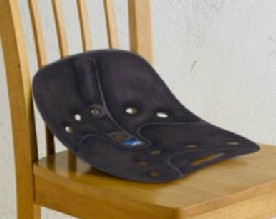 Do NOT place the BackJoy against the back of the chair as you are sitting. If you do, your body cannot move with the BackJoy as you snug and scootch.
 Do I like the BackJoy?
The BackJoy is a great, lightweight, low cost, portable device that works in places and conditions where no other solution is reasonable. I am using it in my home office. I find that my sitting improves enough that my arms move more freely over the keyboard and I have less overall fatigue.Another effect is that my neck position is improved which makes my vision less strained.
In my corporate office, I have a very well-fitting supportive chair. It provides many of the same postural effects. The difference is that with the BackJoy my muscles really do have to work. In the supportive chair I am more relaxed.
I do not believe I would like to use the BackJoy eight hours a day (although some people do so). I think my muscles aren't quite up to it yet. When I do tire, my body tends to slide forward on the BackJoy and I'm sitting on the edge of my chair. I believe there's a conditioning period needed.
Links to U-Tube videos of theory and sitting directions are included below. If the link doesn't work, please copy the link and paste it in your browser's navigation bar.
Three Simple Steps
Science Behind BackJoy
This site needs an editor - click to learn more!

Related Articles
Editor's Picks Articles
Top Ten Articles
Previous Features
Site Map
Content copyright © 2023 by virginia hixson. All rights reserved.
This content was written by virginia hixson. If you wish to use this content in any manner, you need written permission. Contact
BellaOnline Administration
for details.
