

Posture or Position - A Little Jargon

- Abduction (Abducted)
- In general, abduction refers to a movement or position away from the center of the body. Abduction commonly refers to the large body joints – the shoulder and hip. It is occasionally used to refer to smaller joint movement.
- In the shoulder and hip it specifically implies the limb is lifted to the side , not in front of the body.
- In the wrist it refers to a movement or position toward the thumb side of the hand.
- In the thumb it refers to movement or position sideways, away from the palm (not forward of the palm)
- For fingers and toes, it indicates that they are spread, separated apart.
- Adduction (Adducted)
- Adduction is the opposite of Abduction. It indicates a movement or position from the side, toward the body.
- For the shoulder it indicates the arm is at the side of the body
- For the hip the leg is aligned straight down.
- For the wrist, it is bent or moved toward the little finger side.
- For the thumb, it is positioned or moving from a side position back to the side of the index finger.
- For the fingers, they are positioned or moving toward each other.
Awkward Posture- A non-optimal posture for doing a task. Awkward postures range from "ok to do but look for a better way" to "that's ridiculous". The scale is not precise or scientific. How awkward a posture has to be to be problematic depends on
- How long the posture has to be held
- How frequently is must be used
- How much force is required while in the awkward posture
- Other things that have to be done at the same time
- Physical constraints (in tight places)
- Etc.
- Back
- The back is not one structure. Essentially it is composed of the spine and the soft tissues that attach to the spine. The spine is generally considered in three sections, each based on the type of vertebrae that are in the area. The lower back is Lumbar, the mid-back is Thoracic and the upper back is Cervical. Each back section is anatomically designed for a different purpose: the lumbar for support and stability, the thoracic for rotation, and the cervical for flexibility. Although the neck is a part of the cervical spine, it is frequently considered separately.
Center of Gravity- The Center of Gravity is essentially the balance point of an object. It is the one point where there is essentially equal weight at both ends of the object. Finding the center of gravity will make handling an object easier and decrease the effort that needs to be expended. In any movement the body' must have balance. Movement based on the center of balance of the body is more stable, graceful, and efficient.
Dorsal ( Dorsum)- The dorsum refers to the back of the body or limb. If you lie flat on your back on the bed with your arms outstretched and your palms up, everything touching the bed is dorsal.
Dorsi-Flexion (Dorsiflexion)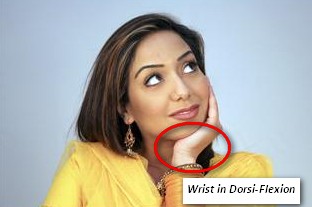
Dorsi-Flexion is a term specific to the wrist, ankle, and hip. Essentially, flexion continues PAST the neutral point. For these specific joints, their articulation and structure is designed to allow the motion. In other joints this is not a normal range of movement and may be termed hyperextension.
Extension- To extend something generally means to make in longer. When speaking about movement, is generally means to make the limb longer, or straighten it out. The body is three dimensional however. Most often when one set of muscles extends, another contracts. In terms of movement, extension can only happen if the limb is already flexed.
- The knee, elbow, wrist,back, fingers and toes are simple. You extend them by straightening them out from the flexed position.
- Hip and shoulder extension is movement of the forward lifted limb back into the resting position– for the hip , moving the leg back to weight bearing position and for the shoulder, moving the arm back to it's position at the side of the body.
Flexion- Flexion is generally understood to be bending the joint – thus a biceps curl is a Flexion exercise. Unless you have bony injury, the strength of your grip is not determined by joint construction but by muscle strength. This concept is true for most joints. Some notable exceptions are the joints in the skull which are essentially immobile.
Hyperextension- Hyperextension means extending beyond the neutral position for the joint. This motion is called Dorsiflexion(or flexion to the dorsal side) for the hip, ankle, and wrist. For these few joints, it is a normal movement. The most functional position for the wrist is actually about 15° of dorsiflexion.
- Shoulder Hyperextension is normal to about 45°. This occurs when your arm is by your side and you reach behind you to tie an apron, pick something up, etc. This position is a weaker posture for the shoulder. tasks that call for this position frequently or for extened periods should be examined closely for alternate methods.
- Spinal Hyperextension occurs naturally when you look up or reach up. It changes all 3 natural spinal curves and affects the distribution of pressure through the spinal discs. Again, in this position the body is weakened. The vertebrae cannot freely move as they are intended to because their spatial relationships have been changed. If a task required frequent or prolonged periods of spinal hyperextension, if should be closely examined for alternate methods or tools.
Joint- The area where two bones meet. They join, therefore joint The bones are connected to each other by tough material called ligaments. Ligaments also connect the bones to muscels. Muscles provide the energy for movment. Most joint are moveable.
Lateral- Movement away from the midline, or a position away from the midline. For example, the little toe is lateral to the big toe.
Medial- Movement toward the midline, or a position closer to the midline. For example, the big toe is medial to the little toe.This can be confusing especially with the hand. But you need to go back and visualize the position of lying on your back flat on the bed, palms up. That's the starting point.
Pronation- Pronation occurs from the elbow to the wrist. Hold your arms at your sides and bend the elbows to 90°. Face your palms toward each other. That is neutral. If you keep your arms in position and turn your hands face down, that's pronation.
Range of Motion- Range of Motion is a measurement of the potential for movement any one joint may have. The optimum position for work is when the joint is in near neutral range. As it moves towards its extremes, there is less strength, resiliency, and tolerance for error.
Radial Deviation- This refers specifically to the wrist. It indicates a cocking or angling toward the thumb side. Radial refers to the forearm bone that is at the base of the thumb.
Side Flexion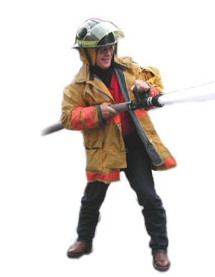
Side Flexion refers specifically to the spine and includes the neck although neck side-flexion may be used if the flexion takes place only in the neck. Side flexion occurs in the thoracic and cervical spine. It is frequently paired with other movements, such as rotation or forward bending.
Supination- Supination is the opposite of Pronation. It also occurs from the elbow to the wrist. Hold your arms at your sides and bend the elbows to 90°. Face your palms toward each other. That is neutral. If you keep your arms in position and turn your hands face up, that's supination.
Ulnar Deviation- Ulnar Deviation is the opposite of Radial Deviation.It indicates a cocking or angling of the wrist toward the little finger. Ulnar refers to the forearm bone that is at the base of the little finger, the Ulna.
Thanks to https://www.internetclipart.com/ for the picture of the Side-Flexing Fireman.
copyrignt © by vhixson nov2011 – all rights reserved.
This site needs an editor - click to learn more!

Related Articles
Editor's Picks Articles
Top Ten Articles
Previous Features
Site Map
Content copyright © 2023 by virginia hixson. All rights reserved.
This content was written by virginia hixson. If you wish to use this content in any manner, you need written permission. Contact
BellaOnline Administration
for details.
