

One Touch Can Opener-Product Review

I got my first One-Touch Can Opener after I experienced a right arm nerve injury. All my cooking was limited, so I depended more on cans than ever before. My right hand was essentially non-functional for several months. Recovery was long and painful. When I moved, I lost the One Touch, couldn’t remember its name, and for more than a year did not have one. When I saw it again I snapped it up!
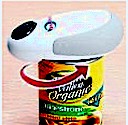 The One-Touch Can Opener looks a little cheap, primarily because of the way it’s generally packaged – in a plastic clamshell. The sleek plastic outer casing, however, fits nicely in the hand is easy to manipulate once you have figured out the correct positioning of the jaw. You place it on the can, push and hold the black button, and magically the gadget begins to open the can. Oh, as soon as the motor starts you can stop holding the button. The One-Touch also automatically shuts off when the job is done.
Admittedly, the first use of this gadget is tricky. There are no obvious guides for use. Looking at the jaw before you place it across the top of the can and repositioning the head will generally do the trick. The blade goes on the outside of the can lip and the cogwheel goes on the inside. The only manually operated part is the on-off button.
Although it has not happened to me in the 6 years I have owned my One-Touch, the motor may apparently miss auto-stopping. In that case, there is a RESET button you can use to stop it and re-set the functions.
Another direction printed on the can-opener that I have never needed to employ is that if the One-Touch stops before the can is completely open, you should press the button again.
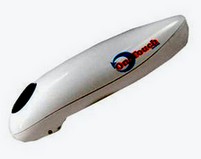
It appears there are two versions available. Mine is the sleeker one shown below. That design fits my hand well. It is 7 inches long, 3 inches wide, 1 ¼ inches tall and approximately 7 inches in circumference. It can be managed either with a full grasp or with a hook grip. Having some mobility in the thenar area (palm area under the thumb) is helpful.
The One-Touch can opener is an easy to use, compact, battery-operated can opener. It works right, left or one handed.
 Like all can openers, the jaw is designed to work within a range. This means that the can opener will have difficulty with cans that have an outside lip too narrow or too wide. It also has a hard time with tiny lids – the turn radius is too small. I have found one can it would not open easily. By removing the can opener and replacing it several times, I was able to get it open – but that opening did result in minor battery degradation.
This can opener works on AA batteries. It’s great for travel or picnics. Some reviews indicated that it used batteries quickly, but mine have lasted more than 9 months – longer than the batteries in my mouse. I believe that battery use depends on how frequently you need to open cans.
The One-Touch Can Opener looks a little cheap, primarily because of the way it’s generally packaged – in a plastic clamshell. The sleek plastic outer casing, however, fits nicely in the hand is easy to manipulate once you have figured out the correct positioning of the jaw. You place it on the can, push and hold the black button, and magically the gadget begins to open the can. Oh, as soon as the motor starts you can stop holding the button. The One-Touch also automatically shuts off when the job is done. Admittedly, the first use of this gadget is tricky. There are no obvious guides for use. Looking at the jaw before you place it across the top of the can and repositioning the head will generally do the trick. The blade goes on the outside of the can lip and the cogwheel goes on the inside. The only manually operated part is the on-off button.
Although it has not happened to me in the 6 years I have owned my One-Touch, the motor may apparently miss auto-stopping. In that case, there is a RESET button you can use to stop it and re-set the functions.
Another direction printed on the can-opener that I have never needed to employ is that if the One-Touch stops before the can is completely open, you should press the button again.
It appears there are two versions available. Mine is the sleeker one shown below. That design fits my hand well. It is 7 inches long, 3 inches wide, 1 ¼ inches tall and approximately 7 inches in circumference. It can be managed either with a full grasp or with a hook grip. Having some mobility in the thenar area (palm area under the thumb) is helpful.
The One-Touch can opener is an easy to use, compact, battery-operated can opener. It works right, left or one handed.
Like all can openers, the jaw is designed to work within a range. This means that the can opener will have difficulty with cans that have an outside lip too narrow or too wide. It also has a hard time with tiny lids – the turn radius is too small. I have found one can it would not open easily. By removing the can opener and replacing it several times, I was able to get it open – but that opening did result in minor battery degradation. This can opener works on AA batteries. It’s great for travel or picnics. Some reviews indicated that it used batteries quickly, but mine have lasted more than 9 months – longer than the batteries in my mouse. I believe that battery use depends on how frequently you need to open cans.
This site needs an editor - click to learn more!

Related Articles
Editor's Picks Articles
Top Ten Articles
Previous Features
Site Map
Content copyright © 2023 by virginia hixson. All rights reserved.
This content was written by virginia hixson. If you wish to use this content in any manner, you need written permission. Contact
BellaOnline Administration
for details.
